
What I Learned About Scansion from Building Poetcraft with Annie Finch
A guest post by Sanya Khurana


I already knew how to hear stress and unstress before I started working with Annie on Poetcraft. I had learned from her, in fact — the basic grammar of it, the feel of the iamb, how to read a line and sense where the weight fell. I thought I was listening.
What I didn’t know was how to see the flow.
Poetcraft is an app Annie and I are building together. The idea is simple and ambitious at the same time: a tool that helps poets scan the meter of their own poems and guides them to write in meter — not as a rule imposed from outside, but as a felt, living practice. To build it, we have had to think very carefully about what scansion actually is, how it works, and how to teach it. That has meant going through poems slowly, line by line, marking every syllable.
Doing this over and over — not reading about scansion, but practicing it — changed something in me. But I’m getting ahead of myself.
Let me take one line from Annie’s poem “Watching the Whale” to show what I mean. The poem is in iambic pentameter — rising meter, the pulse of u / running through it — and most lines scanned without trouble. Then I got to this one:
fixing my mouth, with the offerings of silence,
Annie has five guiding principles for scansion, applied in order. The Principle of Line-Length comes first: a scansion must above all respect the number of feet per line — the metrical contract. The Principle of Simplicity comes next: among valid scansions, the best is the one with the fewest variations from the base meter. The Principle of Direction comes third: when all else is equal, the best scansion follows the overall movement of the meter — rising, falling, or rocking. The Principle of Metrical Context comes fourth: an unusual variation will often make more sense when seen within the context of the poem as a whole. And the Principle of Meaning comes fifth: a good scansion, especially a difficult one, ideally illuminates and deepens the meaning of the poem.
My first attempt:
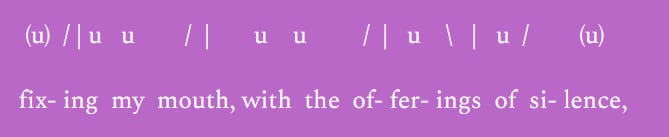
What had gone wrong was that I had jumped straight to the Principle of Direction — the third principle — and applied it as though it were the first. This is a rising poem; iambic meter moves upward, u /, and a trochee at the start of a line feels like it’s going the wrong way. So I reached for a ghost cup to preserve that rising feel: the line opens with a lift rather than a fall, followed by an anapest.
But Direction is third in order for a reason. The Principle of Simplicity comes before it, and Simplicity stops this scan cold. The base meter is iambic pentameter. The simplest scan has the fewest variations from that base. A trochee in the first foot — / u — is a single, standard substitution.
Once I let Simplicity do its work before invoking Direction, the scan resolved. “Fixing” is a trochee. FIX-ing — which is simply how the word sounds.

And then I heard the line differently. “FIX-ing my MOUTH” — the stress landing first on “fixing,” then on “mouth.” It made more sense to put a foot boundary between “fixing” and “my mouth” than between “fix-” and “ing” — even reading it aloud, the division felt right. The wrong scan had buried this. The principle didn’t impose a reading; it cleared the way for a reading that was already in the words.
This is the thing I keep coming back to: you might expect a formal framework like this to constrain a poem, to flatten it into a pattern. The opposite is true. The principles push you toward the scan that is most honest to the language — and in doing so, they bring out the poem’s own voice more fully, not less.
I already knew how to hear stress. That wasn’t the gap. What I didn’t know was how to follow the flow — the way syllables move through and against the metrical frame, creating momentum, hesitation, weight, rush. When I was just listening impressionistically, I caught the emotion of the stanza. When I started applying Annie’s principles — rigorously, syllable by syllable — the poem acquired a different shape. The lines I thought I knew became something else: a physical structure I could trace with my hands, almost. I read the stanza differently after that. I still do.
Sanya Khurana is a Delhi-based technologist, poet, and women’s empowerment advocate. A former Adobe engineer, she now works as a Fractional CTO and is building a metrical scansion app with poet Annie Finch. She co-founded the Lean In India Network, delivered a TEDx talk, and has authored two books. Her contributions to women in tech have earned recognition from Facebook, Google, and the Grace Hopper Celebration.
Sanya also leads the Poetry Witch community with Annie — a global circle for women and gender-nonconforming poets, poetry lovers, and spiritual seekers exploring poetry, meter, and magic. This April, the community is journeying through NaPoWriMo together. Missed prompts are available, so you can begin anytime. You’re warmly invited to join in.
If that's how you want to roll with a line that is only 60 percent iambic. I prefer poets like Shakespeare and Poe who used less foot substitutions.
Yes, Sanya. Nice call.Thanks.